
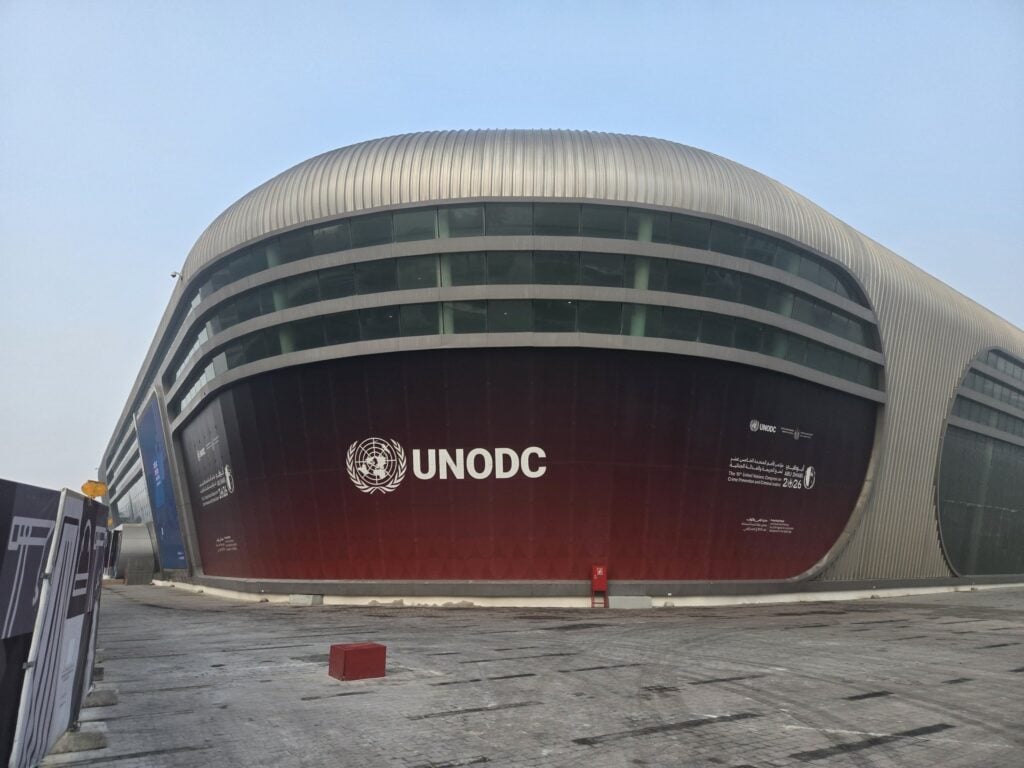
United nations Office on Drug and Crime, UNODC in Vienna organizes a congress every fifth year. Between 26th of September and 1st of October it took place at the ADNEC centre in Abu Dhabi and IPCA was represented by the President Marie-Louise Norozi.
The high-level segment with ambassadors from over 120 states voted to adopt the Abu Dhabi Declaration, under which governments has agreed on actions to strengthen crime prevention and resilience among other things.
You can read more about the declaration on our the UNOCD website, www.unodc.org
For IPCA as an NGO our focus is to learn and to network. To be able to informally present our work, talk about what we as prison chaplains see on daily basis and also present ideas to both ambassadors, UNODC employees and CEO:s of other NGO:s is very valuable to our work.

The new Executive Director of UNODC, Ms Monica Juma held a meeting with representatives of the civil society and was very clear on the importance of NGO:s and FBO:s. She said:
“Crime prevention is not just something on paper – it is reality and civil society lives and works within that reality.”
That word tells a story of many years of working along side with civil society in general. But more specifically, she and the UNODC knows the work we do, they know that IPCA is an organization they can trust and that the work we do is in fact crime prevention.
Because supporting inmates, helping them to see hope of a life outside the prison walls is the first step for them not to commit new crimes. Being able to welcome them into our congregational lives and communities is of course a natural thing. Not something we might view as crime prevention. But it really is!
Speaking from experience, in my own context in Malmö, Sweden far from the Crime Congress level of discussions: once an ex-inmate is seen as anything but a criminal, feels appreciated for who he or she is as a person. There is a chance that the new identity – as somebody that is welcome inside a safe and loving community – is much more interesting than going back to the criminal world filled with fear and violence.
This is our strength as a global network of prison chaplains. We have our own roots in Christian congregations. Sometimes they might not be too keen on our work, but in many cases, it is in fact the opposite – parishioners might be part of prison visiting groups, helps collects cloths and other items needed when an inmate leaves the prison. And even employs them once they have served their time. It is Gods work, but at the same time very much crime prevention. This is something for us to be proud of being a part of.
Marie-Louise Norozi, President/CEO